

Strike drones of the Ukrainian Defense Forces struck the largest chemical plant in southern Russia, Nevinnomyssk Azot, located in the city of Nevinnomyssk in the Stavropol Krai.
This was reported by the Astra Telegram channel.
The attack took place on the night of May 15–16, 2026, after a drone threat was declared in the region at 1:19 A.M. Photos and videos of the fire later began circulating online.
According to an analysis of materials by Astra journalists, the source of the fire was located directly on the chemical plant’s grounds.
However, regional authorities have not yet confirmed the attack on the facility. Thus, Governor Vladimir Vladimirov wrote on his Telegram channel that there was no damage on the ground as a result of repelling the raid.
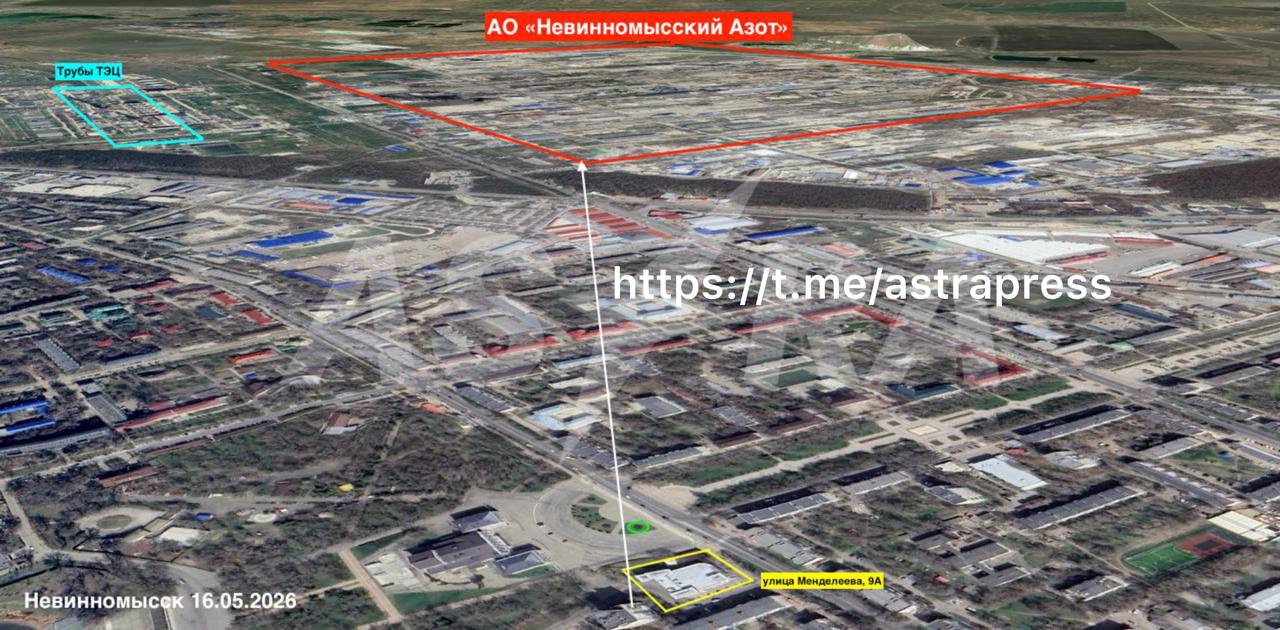
It is worth noting that this plant is not a first-time target for Ukrainian drones. In particular, on March 19, 2026, drones had already attacked the plant’s territory.
At that time, local residents reported four strikes, and a strong, unpleasant odor was detected in the city. Additionally, similar attacks also occurred in January 2026, as well as in December and August 2025.
Nevinnomyssk Azot, part of the EuroChem holding company, is a strategically important enterprise that produces ammonia, nitrogen fertilizers, as well as nitric and acetic acids.
It is the largest producer of nitrogen fertilizers and ammonia in Russia.
The plant is located approximately 400 km from Ukrainian-controlled territory at coordinates 44.65905524796034, 41.940008762580746
According to Reuters, from 2022 to 2024, the plant, together with Novomoskovsky Azot, supplied at least 38,000 tons of acetic acid and nearly 5,000 tons of nitric acid to the Sverdlov Plant in the Nizhny Novgorod region of Russia, which are used to produce explosives, specifically octogen and hexogen, for artillery shells.
Earlier, Militarnyi reported that the leading Russian chemical plant KuibyshevAzot in the city of Togliatti, the Samara region, suspended operations following a Ukrainian attack on the night of March 30, 2026.

