
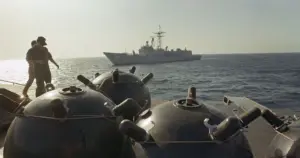
Iran is unable to fully open the Strait of Hormuz to shipping because it cannot locate all the sea mines it laid itself.
This is reported by The New York Times, citing senior US officials.
The publication notes that Tehran lacks the technical capabilities to quickly neutralize them.
This situation prevents Iran from promptly fulfilling the Trump administration’s demand to increase the capacity of this strategic waterway, through which a significant portion of the world’s oil exports passes.
The Islamic Revolutionary Guard Corps (IRGC) chaotically mined the strait using small boats immediately after the start of US and Israeli military operations against Iran in March 2026.
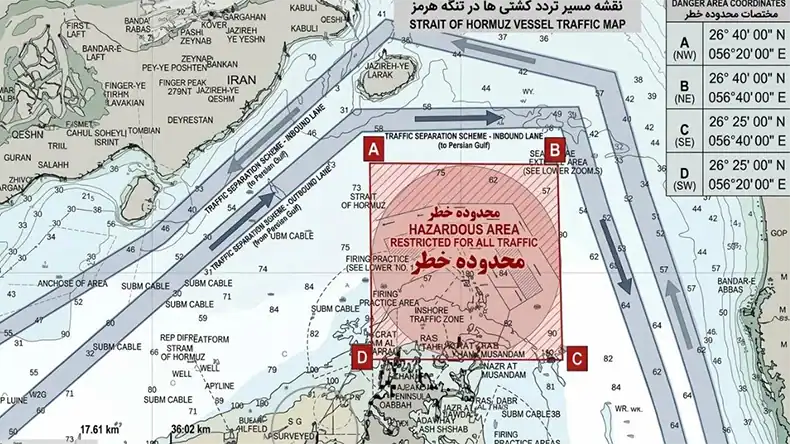
US sources note that the Iranians likely did not record the exact coordinates of each mine. Additionally, ocean currents may have shifted the mines, or they may have been placed in such a way from the outset that they are easily dislodged.
“Even when the location is known, Iran is unable to quickly remove the mines. The same applies to the United States—we also have limited mine-sweeping capabilities in this region,” the NYT quotes US officials as saying.
This issue directly impacts the ongoing peace talks. The Iranian delegation is in Pakistan to discuss the terms of a ceasefire, but the delay in reopening the strait is complicating the achievement of an agreement.
The Strait of Hormuz remains one of the most critical ‘chokepoints’ for global trade, as about 20% of the world’s oil is transported through it daily. During the conflict, Iran used mine-laying as a tool of pressure, but now this tactic has backfired on Tehran itself.
Currently, only limited ‘safe corridors’ designated by the Iranian side are open through the Strait, but these are insufficient to restore normal shipping.
The challenge of demining the Strait of Hormuz
The number of minesweepers in the region remains extremely limited for both Iran and the United States. Despite a significant arsenal of naval mines (estimated at 2,000 to 6,000 units), Tehran has virtually no modern specialized minesweepers.
The country relies primarily on small boats of the Islamic Revolutionary Guard Corps (IRGC) and the limited capabilities of Ghadir-class submarines for laying mines.
However, the Iranian forces have almost no systems for their effective detection and neutralization. That is why even detected mines often remain in place, and haphazard mining without precise coordinate recording only exacerbates the situation.

The United States also faces serious challenges in countering the mine threat. In September 2025, the US Navy decommissioned the last four Avenger-class minesweepers, which were based in Bahrain and had ensured mine safety in the Persian Gulf for decades.
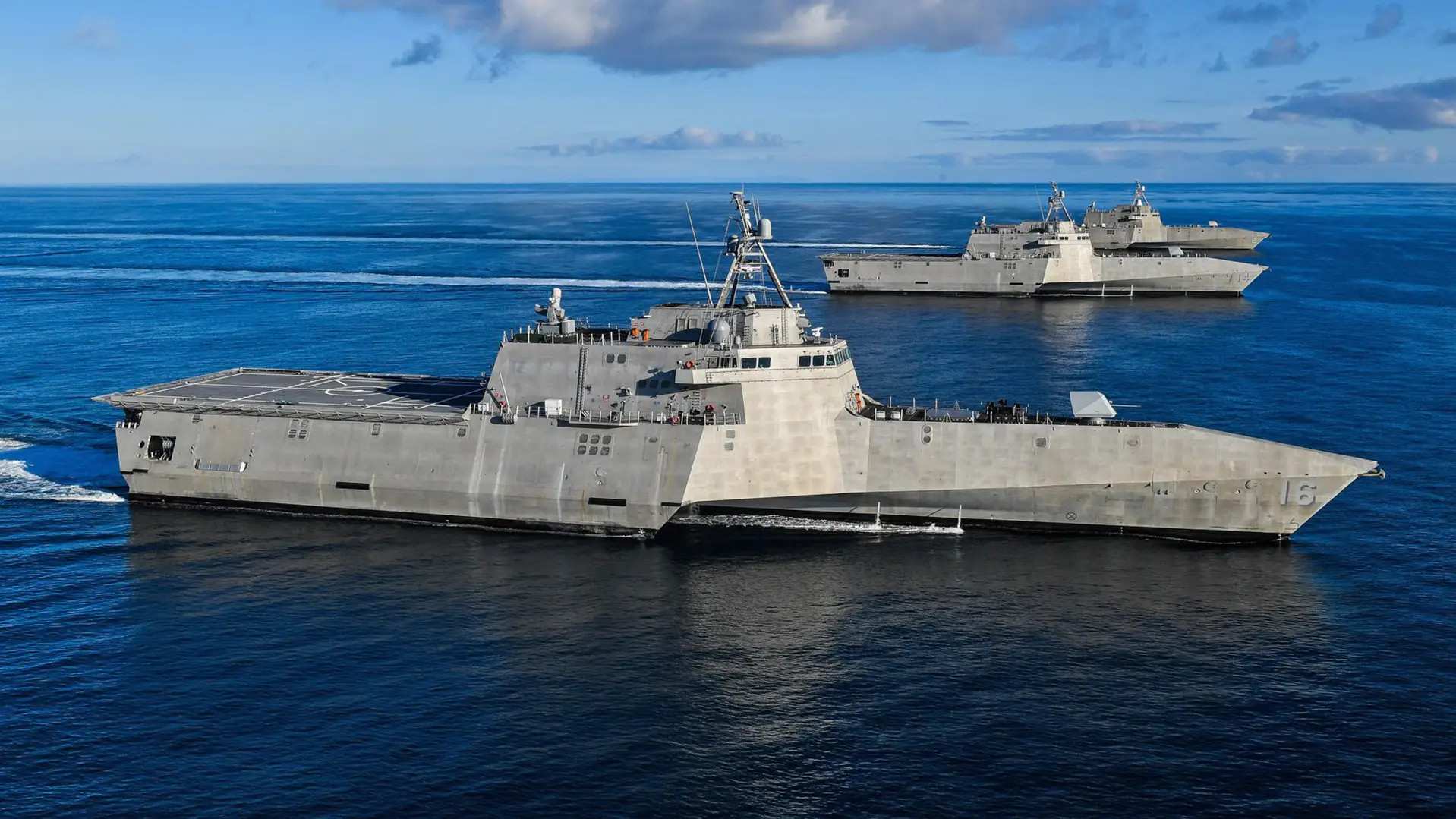
They were replaced by Independence-class Littoral Combat Ships (LCS) equipped with the Mine Countermeasures Mission Package (MCM Mission Package).
This package includes unmanned surface and underwater vehicles, MH-60S helicopters, and sonar systems that allow operations at a safe distance from minefields.
However, the technology has not yet been fully tested in real combat conditions, and the ships themselves (USS Canberra, USS Santa Barbara, and USS Tulsa) were partially outside the region—in Singapore, Malaysia, and the Indian Ocean—at the start of the conflict.
Overall, forecasts suggest that clearing the Strait of Hormuz could take weeks or months.
Iran and the US acknowledge that modern mine countermeasures require significantly more time and resources than laying mines. A shortage of specialized minesweepers, a limited number of proven unmanned systems, and the risk of repeat attacks complicate the full restoration of navigation.
This is forcing diplomats in Pakistan to take into account the ‘technical limitations’ mentioned by Iranian Foreign Minister Abbas Araghchi during discussions on the terms of a ceasefire.


