
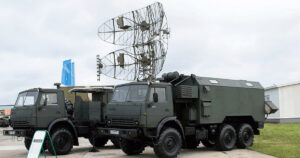
OSINT sources have reported a decrease in the number of Russian low-altitude radar systems, Kasta-2E2 and Podlyot, along the Russia–Finland border, likely because they are being redeployed to Ukraine.
According to OSINT researcher Athene Noctua, who analyzed satellite images and shared the findings on X, the radars are installed on special masts due to the dense forest terrain. Nearby, support vehicles handle command post functions and other equipment needed for radar operation.
Many of the former deployment sites for Kasta-2E2 and Podlyot-K1 radars now appear abandoned, showing no signs of activity.
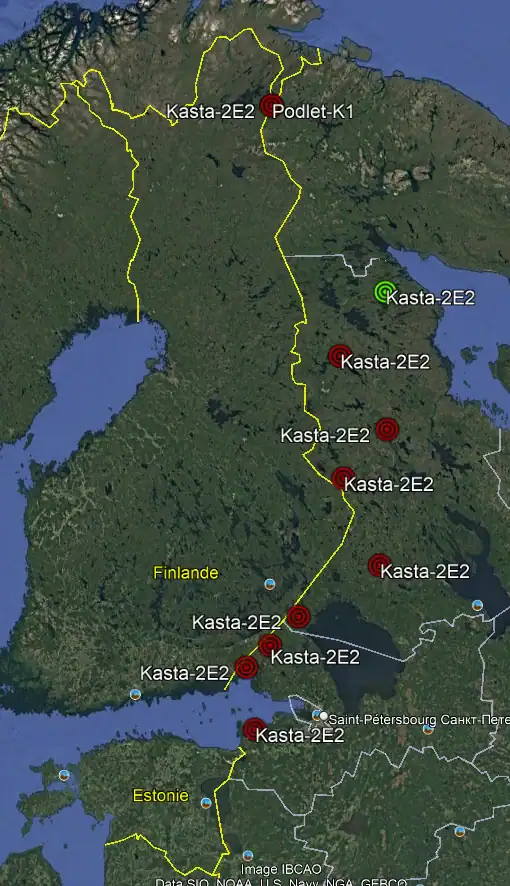
One such site was a radar unit located a few kilometers from the large Russian oil port of Ust-Luga, which has recently been repeatedly struck by Ukrainian drones.
According to the OSINT researcher, this clearly illustrates the effectiveness of Ukraine’s campaign to target Russian air defenses, as Russia is forced to withdraw coverage in the direction of a new NATO member.
As you can see here, by Sept 2024, the site has been in decay. 4/8
59.725863, 28.493644 pic.twitter.com/bhbSeH7LGs— Athene Noctua (@Ath3neN0ctu4) March 30, 2026
Kasta-2E2 and Podlyot-K1 Radars
The 39N6 Kasta radar is a mobile, two-coordinate, decimeter-band radar with 360-degree coverage. It is designed to monitor airspace, determine the coordinates, and identify aerial targets, including those at extremely low altitudes.
The station can detect targets at distances of up to 150 kilometers and is reported to be capable of operating under conditions of heavy electronic countermeasures.
Information about target coordinates and movement parameters is transmitted to air defense command systems, the Aerospace Forces, and army air defense via radio channels or cable connections, with the option for digital-analog interfacing.
Podlyot is a centimeter-band radar designed to operate with Russian S-400 and S-300PMU-2 air defense systems.
The Podlyot-K1 can detect targets at ranges between 10 and 300 km and at altitudes up to 10 km, operating in low-altitude, high-altitude, long-range, and mountainous modes, and can provide target designation for surface-to-air missile systems.
