
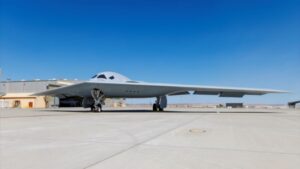
The head of U.S. Strategic Command (STRATCOM), General Anthony Cotton, has called for a major increase in the number of next-generation B-21 Raider stealth bombers.
Speaking at a Senate Armed Services Committee hearing, he said the original plan to acquire 100 aircraft is no longer sufficient to address current threats. In his view, the U.S. Air Force needs at least 145 B-21 bombers to effectively deter Russia and China.
To support this expansion, the Department of Defense is considering boosting its industrial capacity, including the possibility of opening a second assembly line. This would allow production to scale up well beyond initial projections.
With a larger order, the United States could sustain a total fleet of around 220 strategic bombers. This would include new B-21 aircraft built by Northrop Grumman, along with upgraded B-52J bombers equipped with modern Rolls-Royce engines.

Anthony Cotton emphasized that stable and continuous production is critical to replacing aging B-1 Lancer and B-2 Spirit bombers. The Pentagon aims to avoid a shortfall in combat aircraft, as older platforms are quickly reaching the end of their service life.
B-21 Raider
The B-21 Raider is the newest American strategic stealth bomber, developed by Northrop Grumman.
The program officially began in 2011 under the name Long Range Strike Bomber (LRS-B). After a lengthy competition, on October 27, 2015, the Pentagon selected Northrop Grumman as the project’s main contractor. By 2018, the developers had completed a critical design review, allowing construction of the first test aircraft at Plant 42 in California.
The first official unveiling of the aircraft took place on December 2, 2022, marking the first public rollout of a new American bomber in three decades. On November 10, 2023, the aircraft with serial number ‘001’ completed its first flight, relocating to Edwards Air Force Base for further testing.
In January 2024, the U.S. Department of Defense signed a contract for initial production (LRIP), and by September 2025, a second production aircraft joined the flight test program.
The average cost of a single aircraft is approximately $750 million in 2024 dollars. Total development, procurement, and operational costs for the fleet over 30 years are estimated at $203 billion. In March 2026, the budget request to support the program exceeded $10 billion, part of which will be allocated to preparing a second assembly line.

