

Australian scientists have carried out the first sea trials of a portable atomic clock aboard a Royal Australian Navy vessel. The breakthrough could enable highly accurate navigation systems that work without relying on satellite signals (GNSS).
The University of Adelaide reported the development.
The tests took place on the Royal Australian Navy training ship Sycamore and were led by a team from the university’s Institute for Photonics and Advanced Sensing.
During testing, the device operated continuously for several days and maintained stable performance despite motion, vibrations, and changing marine conditions. According to the researchers, the system demonstrated the same level of accuracy as it does in laboratory settings.
The new device differs from traditional atomic clocks, which are typically designed for stationary use in controlled environments and have limited mobility.
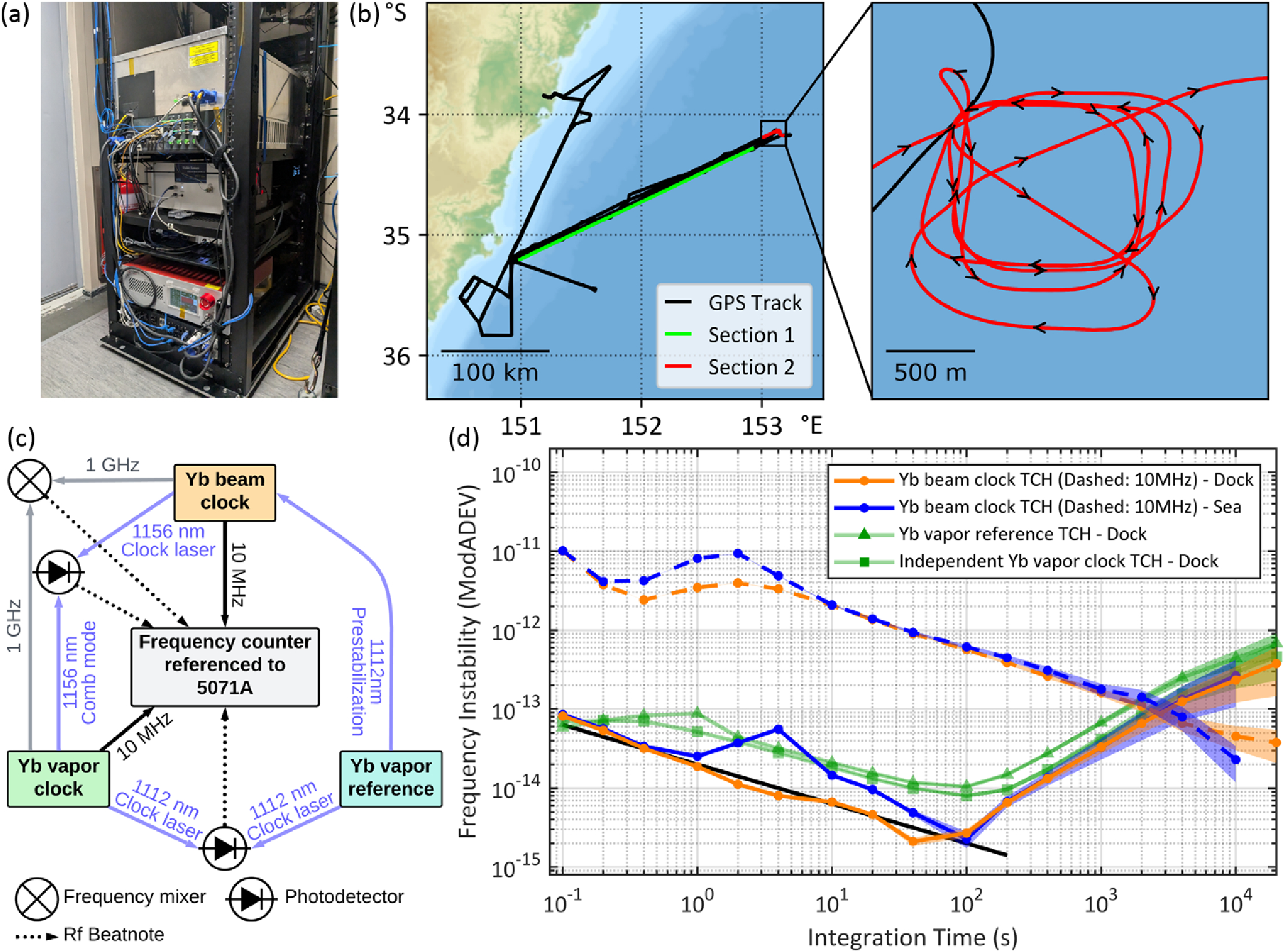
The system uses oscillations of laser-cooled ytterbium atoms to enable extremely precise time measurement.
The technology has potential applications in military navigation, particularly for more accurate positioning in environments where GPS signals are unavailable or jammed. It could also be used in telecommunications to improve the synchronization of large data transmission networks.
It is important to note that atomic clocks do not determine coordinates on their own; rather, they provide ultra-precise time, which is a fundamental variable in navigation. In most systems, positions are calculated by measuring signal travel times or changes in motion, so the more accurate the clock, the more precisely a location can be determined.
A stable atomic clock enables more accurate measurement of time intervals and supports the use of alternative positioning sources, such as radio beacons, systems like eLoran, or synchronized sensor networks.
In 2025, the U.S. military spaceplane X-37B conducted tests of a quantum navigation system.

In a Space Force press release, the system was described as “the most effective quantum inertial sensor ever tested in space.”
Earlier, Boeing tested a quantum inertial measurement device using atomic interferometry to determine acceleration and rotation on conventional aircraft.
A more advanced version of this technology was later tested in space to evaluate precise positioning, navigation, and timing in environments where GNSS access is unavailable.


