

For the first time in the world, Ukraine’s Unmanned Systems Forces destroyed a kamikaze drone using another drone launched from an unmanned surface vessel (naval drone).
The Unmanned Systems Forces reported that the operation was carried out by operators of the unmanned surface systems unit of the 412th Nemesis Brigade, who successfully shot down a Russian Shahed-type loitering munition.
The use of unmanned surface platforms to deploy interceptor drones significantly expands capabilities to counter aerial threats and adds an additional layer of air defense for Ukrainian cities.
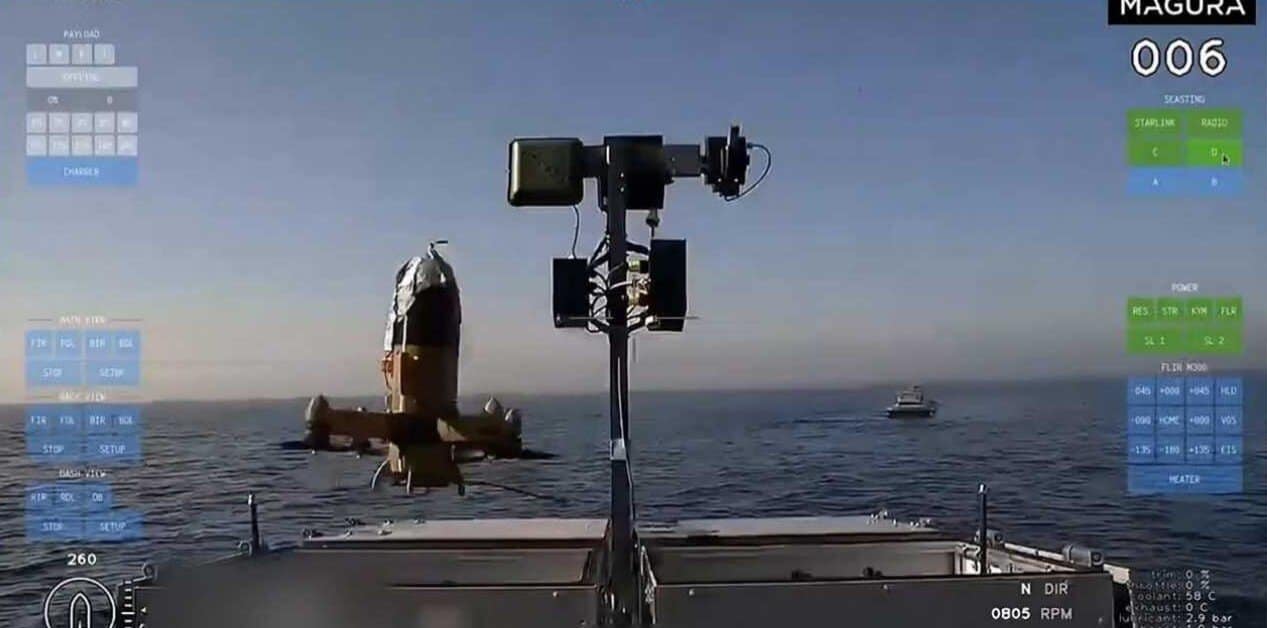
The specific unmanned surface vessel used as the carrier has not been disclosed. However, in March, reports emerged that a Ukrainian naval drone from the Magura series had received a new modification designed to launch interceptor drones.
Based on this, the footage may show a platform built on the Magura series, though it could also be a different system.
The video also indicates that the unmanned surface vessel is equipped not only with a launcher for interceptor drones, but also with a machine-gun combat module – likely for self-defense and engaging nearby targets.
It is worth noting that the use of naval “drone carriers” is not a new practice for the Ukrainian Defense Forces.
In particular, similar solutions are already employed by the Navy: in early March, a Russian Ka-27 helicopter was destroyed using this method.
In late March, several remote-control systems for unmanned vehicles were used simultaneously in Ukraine, which may have contributed to interceptions at sea.
In particular, during a large-scale drone attack, at least two systems were employed: one of an unspecified type, and another – HORNET VISION Ctrl.
The deployment of such technologies significantly enhances the safety of interceptor drone operators by reducing the risk of being struck by Russian UAVs or affected by accidental detonation of warheads. Operators can control the drones remotely from protected locations, including underground command centers.
In addition, these solutions enable the pre-deployment of autonomous launch containers along likely flight routes of Russian drones, as well as their integration onto mobile platforms, such as vehicles or boats, and their remote activation.


