
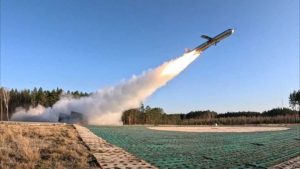
The European company Destinus has shown the second generation of its Ruta cruise missile, the previous version of which is used by Ukraine to strike Russian targets.
Militarnyi spoke with the developer about the new version of the Ruta missile.
The new modification is called Ruta Block 2 and, at first glance, shows significant differences from its predecessor.
The company said that the new missile demonstrates a clear and consistent architectural evolution of the platform. The key change was the transition to a container launch method, which necessitated the use of a complex wing configuration and a built-in solid-fuel linear launch accelerator.
This approach significantly increases the missile’s security during storage, transport, and deployment, and greatly simplifies its integration with various launch systems, including ground and sea platforms.

As a result, the product becomes more versatile and adaptable to different application scenarios.
At the same time, Block 2 focuses not on the introduction of fundamentally new systems, but on scaling combat characteristics through in-depth aerodynamic and structural optimization, which allows for increased efficiency without complicating the production cycle.
Ruta Block 2 is currently in the testing phase. The transition to serial production is planned after the completion of this phase and the qualification procedure in accordance with the customer’s requirements.
The company refrains from publicly disclosing information about Ruta Block 1, as well as any aspects of its operational use or the deployment of individual configurations.
Analysis of the changes
First of all, the aerodynamic design has changed: the rocket fuselage has become box-shaped, whereas in the first version of Ruta Block 1 it had a classic cylindrical shape.
Like its predecessor, Block 2 is designed as a high-wing aircraft with a rectangular wing, but the design of the folding wing has been revised.
While Block 1 had an external deployment mechanism, the new version has it integrated directly into the fuselage.

The tail section underwent minimal changes and retained its classic configuration: a keel and two stabilizers. At the same time, the engine exhaust is now located in a trapezoidal casing.
Although the new hull shape is somewhat reminiscent of a low-radar-visibility design, it should be understood that this is not a stealth missile.
The box-shaped design has a number of practical advantages — it is cheaper to manufacture and scale, easier to transport, and simplifies modular replacement of components.
According to the company, the missile is capable of hitting targets at a distance of up to 420 km and carrying a warhead weighing up to 250 kg.
For comparison, according to some data, Ruta Block 1 can fly a distance of about 300 kilometers (according to some data, 500) and has a warhead weighing approximately 100 kilograms.


