
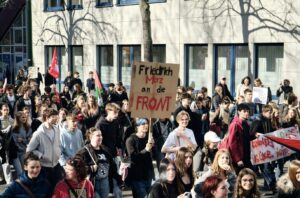
Thousands of students across Germany took to the streets to protest against the expansion of the German military and the possible reinstatement of mandatory military service.
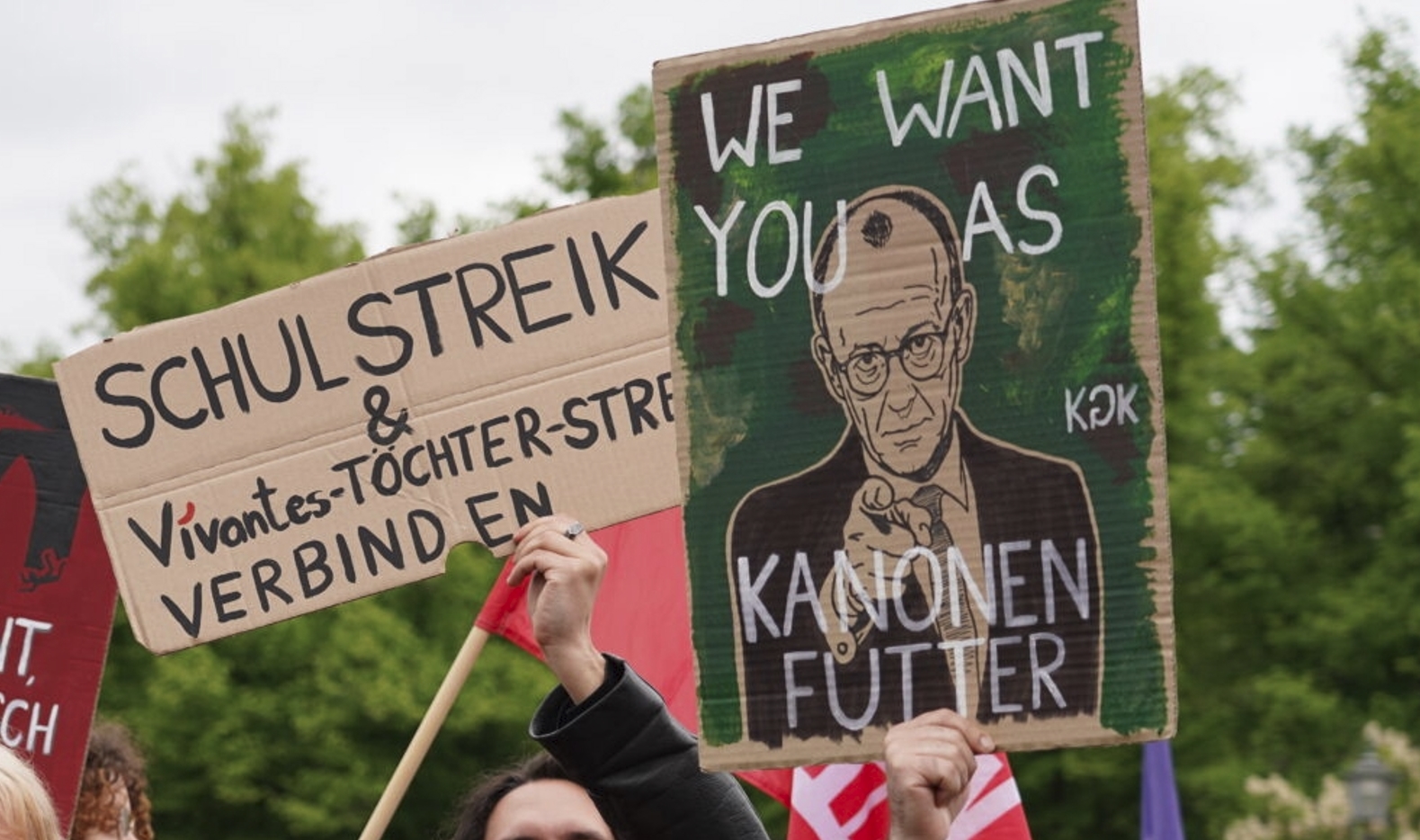
According to the protesters, as reported by The Guardian, the strike action aims to stop the rearmament policy, which, in their view, turns young people into ‘cannon fodder.’
“The government and industry are preparing for war, and we, the youth, are supposed to become cannon fodder. No one even asked us,” Hannes Kramer, the main spokesperson for the Schulstreik gegen Wehrpflicht (“School Strike Against Conscription”) movement, told the publication.
According to Kramer, the protest reflects the anxiety prevailing in homes and classrooms across Germany after Friedrich Merz’s government changed military service policy, arguing that it was necessary to strengthen the country’s defense amid the growing threat from Russia following its full-scale invasion of Ukraine.
Under the Military Service Modernisation Act, all 18-year-olds are sent mandatory questionnaires to assess their readiness and fitness for service.
Mandatory medical examinations will also be introduced starting next year.
In addition, the law contains a provision under which men aged 17 to 45 will theoretically be able to travel abroad for more than three months only with the permission of the armed forces.
The law, passed in December, does not yet provide for the return of mandatory conscription. At the same time, Defence Minister Boris Pistorius stated that this option is still being considered if the new policy does not provide a sufficient number of recruits.
According to experts, the professional army needs to increase by approximately 80,000 troops—to 260,000—over the next 10 years. The reserve, in turn, is expected to grow by 140,000—to 200,000—over the same period.
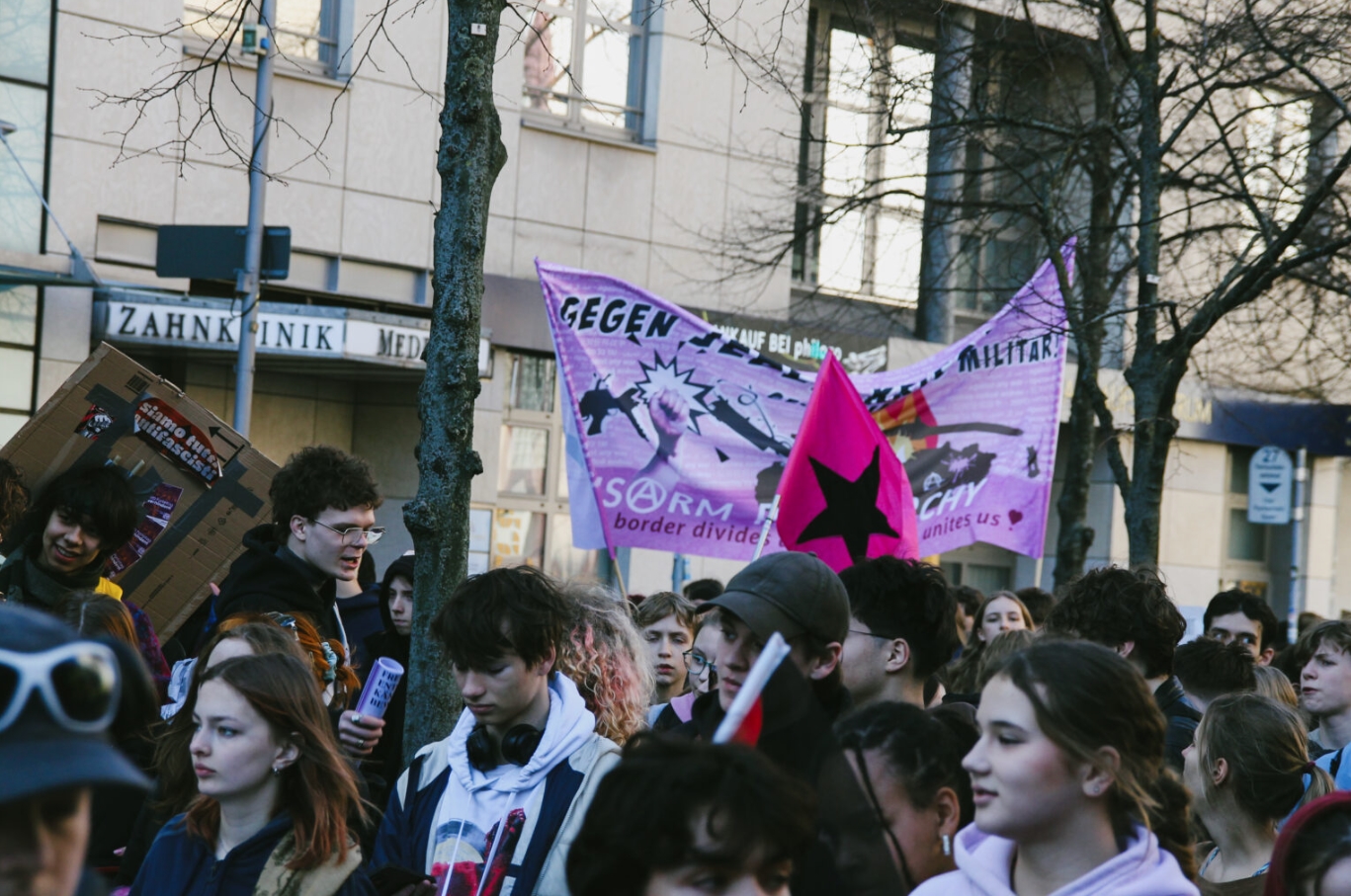
The third school boycott in five months was deliberately timed to coincide with the anniversary of the victory over the Third Reich—amid warnings from organizers that the restoration of Germany’s military power could set the country on a dangerous path toward a new conflict.
“VE Day on 8 May, 1945 was the day of the defeat of German fascism in Europe,” said 21-year-old Kramer, a student of educational science at the University of Göttingen. “We use this date to remind people of the consequences of war and what uncontrolled militarization can lead to.”
“Currently, nearly half of the federal budget is spent on tanks, bombs, and infrastructure to prepare the country for war,” he said, adding that then as now, “large German companies, arms manufacturers, and banks stand to profit.” “We are very afraid that we have not learned the lessons of history.”
The development of the German Armed Forces
Concerned not only by Russia but also by the shift in transatlantic relations following Donald Trump’s return to the White House, the German government announced its intention to invest €779 billion in the defense sector by the end of the decade—roughly twice as much as in the previous five years.
This will enable the country to exceed NATO’s target of defense spending at 3.5% of GDP by 2030.
Merz presents the rearmament drive as vital for the long-term security of Germany and Europe.
In his first speech to the Bundestag as chancellor, he stated that a well-funded German army is “what our friends and partners expect of us; moreover, they demand it.”
The phrase “If you want peace, prepare for war” has become his government’s motto.
However, Kramer stated that rearmament itself could ultimately drag Germany into war.
“Although the situation is different and Germany is not currently under a fascist regime, we see parallels in the rhetoric of German ambitions for global influence and power through military might,” he said. “Presenting the current militarization and preparations for war as ‘defense,’ as Merz does, constantly asserting that Germany, as one of the world’s largest economies, must become a global power—this is frightening, horrifying, and very dangerous.”
During the last demonstration in March, students protested in approximately 150 cities and settlements, carrying signs with slogans such as: “The rich want war, the youth want a future.”
Other signs read: “Dying is not on the schedule,” “Friedrich Merz to the front!” “Our only war is the class war,” and “Education instead of army physicals.”
Across the country, protesters repeatedly highlighted the stark contrast between Germany’s multibillion-euro spending on rearmament and its underfunded education system.
In Koblenz, one protester held a sign asking: “Why should I fight for a country that is not even capable of fighting for us young people?”
Kramer, a member of the Socialist German Workers Youth (SDAJ), stated that the movement grew out of a collective feeling among students “that their right to self-determination is being curtailed.” According to him, the realization that they could be forced to fight is “part of a series of crises that young people have faced in recent years, even before the pandemic, and which have shown them that politicians are ignoring them.”
“Schools are falling apart; even in this, one of the richest countries in the world, there is a shortage of teachers; the deteriorating housing situation is forcing many to live with their parents; and young people’s concerns about the climate have long been ignored.”
Although the government isn’t forcing anyone to join the military yet, Kramer believes it’s only a matter of time: “I believe in the future it will be hard to refuse to serve.”


