
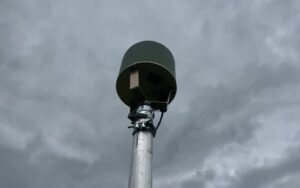
Ukrainian FENEK acoustic systems have been upgraded to detect Shahed-type drones, cruise missiles, and unmanned aerial vehicles via fiber-optic cables.
The manufacturer told Militarnyi that the FENEK is capable of detecting Shahed-type drones at a distance of up to 3 kilometers, and cruise missiles—up to 5 kilometers.
Particular emphasis is placed on its effectiveness against fiber-optic-controlled drones, which do not emit radio signals and remain invisible to electronic intelligence and electronic warfare systems. The system’s main feature is its passive operating principle: it merely ‘listens’ to the surrounding space, making it invisible to electronic warfare systems.
The FENEK consists of a network of acoustic sensors integrated into a single system.
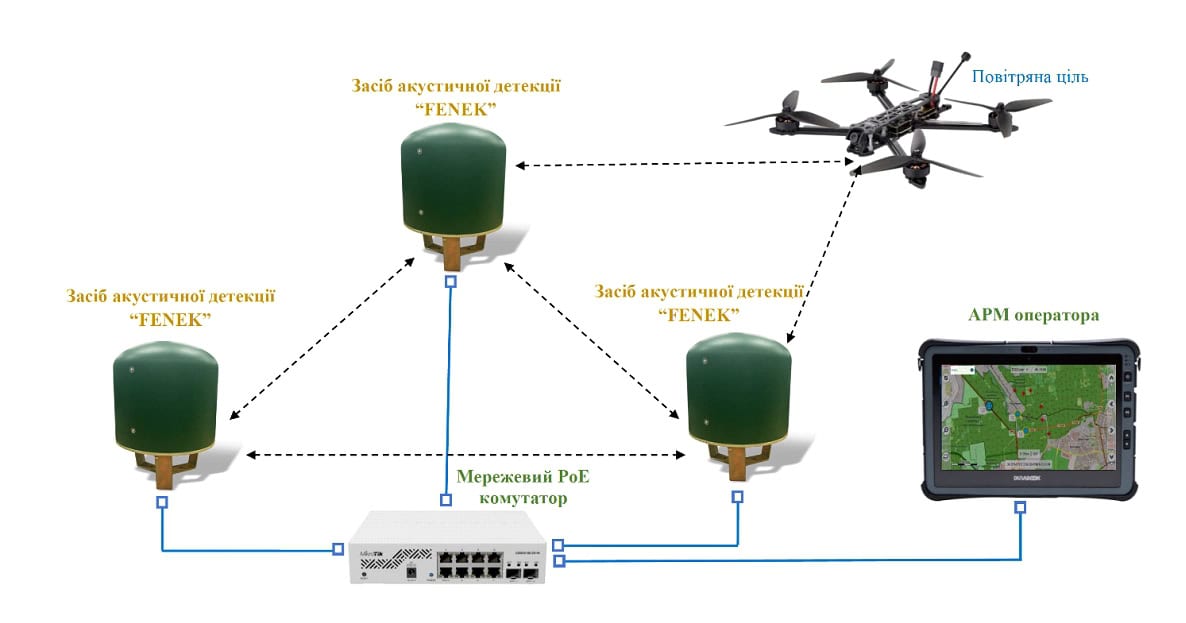
Each sensor is equipped with an acoustic array comprising several microphones and a processing module that analyzes sound, filters out noise, and determines the direction of the signal source.
To do this, the TDOA (Time Difference of Arrival) method is used. The system records the minimal delays between signals at different microphones and determines exactly where the sound is coming from.
A single sensor can only determine the direction of the target, so the network architecture plays a key role. Multiple sensors transmit data simultaneously, after which the system calculates the object’s coordinates using triangulation.

In urban environments, the system can also detect explosions and loud incidents and assist in security monitoring. FENEK can operate both autonomously and as part of larger control systems.
Data is transmitted to an automated operator workstation that does not require an internet connection. An electronic map displays the coordinates of targets, their movement, direction, and speed. The operator can also listen to audio from the sensors in real time for additional verification.

Against the backdrop of the growing role of drones in modern warfare, acoustic technologies are viewed as one of the methods for early threat detection, where sound itself serves as the first signal of their presence.


