
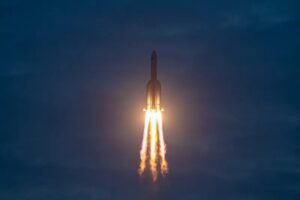
China has submitted applications to the International Telecommunication Union (ITU) to deploy super-large satellite groups. The documents mention a potential fleet of up to 203,000 devices in low Earth orbit.
The declared scale significantly exceeds the current global market figures. This has attracted the attention of analysts and the space industry, according to Bloomberg.
The news agency also provides statistics: for comparison, SpaceX’s Starlink network already has nearly 10,000 active satellites. The system remains the largest active constellation in LEO (Low Earth Orbit).
Bloomberg also notes that Chinese applications may be regulatory in nature. This refers to the reservation of frequencies and orbital positions without guaranteed implementation.
Submissions to the International Telecommunication Union allow countries to fix spectral resources. Such applications are taken into account during international coordination.

This practice creates technical limitations for competitors. Operators are forced to take potential radio interference into account in advance.
The context for these decisions is the rapid growth in the number of devices in orbit. Since 2020, the numbers have increased several times over.
Experts warn of the risks of LEO overload. This refers to both spectral conflicts and the threat of cascading collisions.
The Falcon 9 rocket remains a key factor in SpaceX’s dominance. The reusable system ensures low launch costs and a high rate of satellite deployment.

Analysts emphasize the technological gap between operators. The lack of similar launch capabilities limits the scalability of competitors.
Despite China’s ambitious plans, Elon Musk retains market leadership. It is the pace of launches that currently determines the balance of power in low orbit.
WMilitarnyi recently mentioned the topic of satellite telecommunications space as it relates to Ukraine in the article Starlink – a new story of protecting SatCom sovereignty.


