

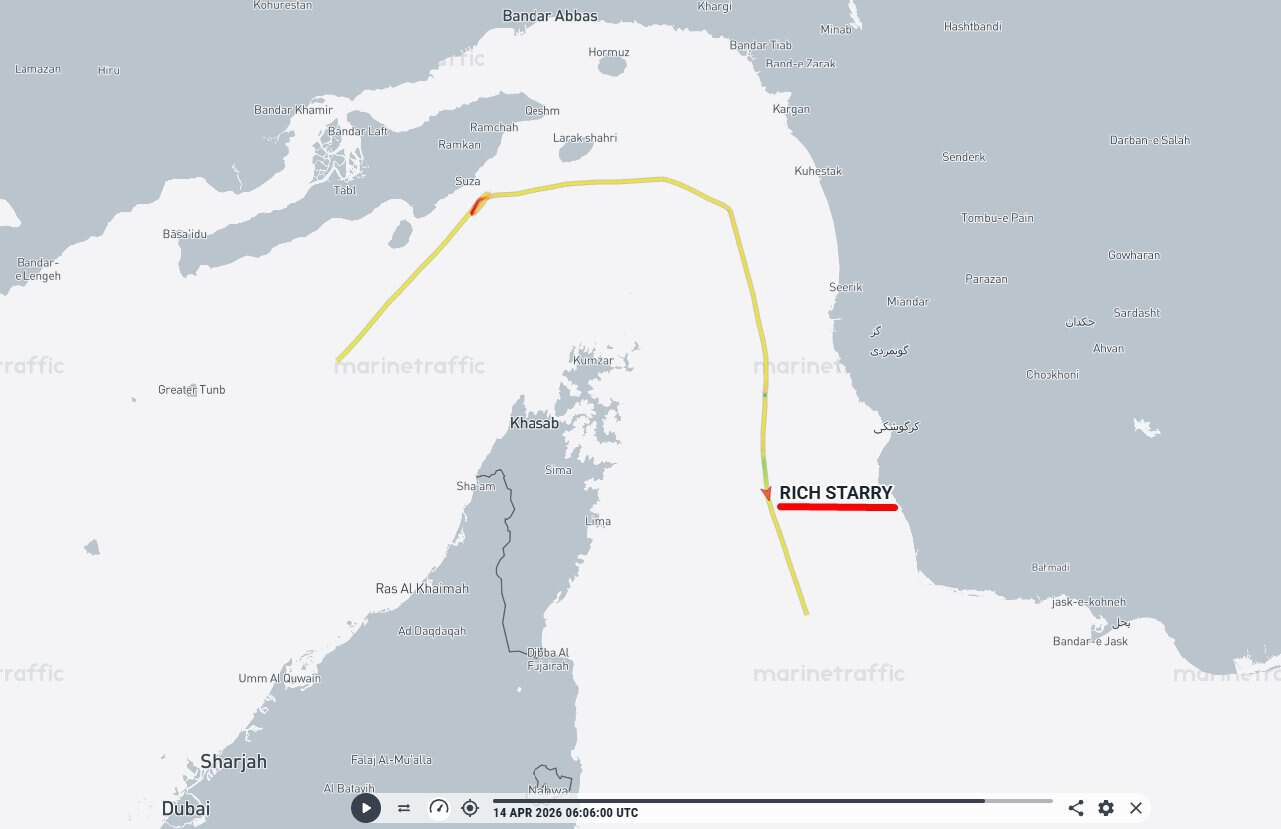
A Chinese tanker under sanctions, Rich Starry, has returned to the Strait of Hormuz after earlier slipping past the U.S. Navy blockade and entering the Persian Gulf.
Reuters reports that the vessel was one of at least eight ships that passed through the strait on the first day the restrictions were imposed. However, U.S. officials state that some of those ships later complied with Navy instructions and changed course.
The tanker Rich Starry and its owner, Shanghai Xuanrun Shipping Co., are subject to U.S. sanctions for cooperating with Iran. The vessel, an MR-class (medium-range) tanker, is carrying about 250,000 barrels of methanol loaded at the port of Hamriyah (UAE). It is currently anchored off the coast of Iran.
On April 14, reports had already emerged that the vessel had passed through the restricted zone.
Another sanctioned tanker, Murlikishan, also entered the Strait of Hormuz on April 14. It is expected to load fuel oil in Iraq on April 16.
At the same time, U.S. Central Command stated that during the first 48 hours of the restrictions, no vessel was able to pass U.S. forces without interference.
In addition, nine vessels complied with U.S. forces’ demands and changed course, returning to Iranian ports or coastal waters. Rich Starry was likely among them.
The imposed restrictions have significantly increased uncertainty for shippers, oil companies, and war-risk insurers.
According to industry sources, shipping traffic has dropped sharply and now accounts for only a fraction of the more than 130 daily transits recorded before the start of the U.S.-Israeli war against Iran on February 28.

As previously reported, Donald Trump ordered the U.S. Navy to begin a full blockade of the Strait of Hormuz on April 12.
Trump stated that no vessel would be allowed to enter or leave the strait from that point on, but added that the U.S. might “at some point” reconsider this policy. However, the U.S. president did not specify the conditions under which this could happen.
The reason for imposing the blockade, according to Washington, is Iran’s actions, which, as Trump stated, restricted transit through the strait due to the presence of naval mines.
The mines have also become one of the factors slowing down negotiations between the United States and Iran in Pakistan.
The U.S. President also ordered the Navy to identify and, in international waters, detain any vessel that has paid transit fees to Iran. In addition, he announced the launch of a campaign to clear the strait of mines, though he did not specify how this would be carried out.


