
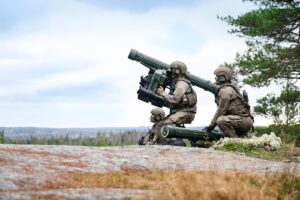
Swedish company Saab has unveiled the new Bolide 2 missile for the short-range RBS 70 air defense system. The missile features a more powerful warhead, is better optimized for intercepting UAVs down to the size of a DJI Mavic, and incorporates an improved modular design.
The company announced this in an official press release.
According to Saab, Bolide 2 retains the laser beam-riding guidance system used in the previous missile version and remains compatible with both RBS 70 NG launchers and earlier-generation systems, which have also been in service with the Ukrainian Defense Forces since 2023.
“The original Bolide was capable of engaging a DJI Mavic. But Bolide 2 will be able to do this even more effectively,” said Mats-Olof Rydberg, head of Ground-Based Air Defence at Saab, during a briefing.
According to the company, development of the new missile began 4.5 years ago and was completed on schedule and within budget. Deliveries of Bolide 2 are set to begin in 2027, and the new missile will become the standard munition for the RBS 70 NG.

“With Bolide 2, we are ready to offer our customers an even more capable missile that can be adapted to counter new aerial threats. Operators of the RBS 70 will benefit from the upgrades, including a more powerful warhead, whether the system is used in its man-portable configuration or – as is increasingly the case — mounted on a vehicle-based combat module,” said Stefan Öberg, head of the Missile Systems business unit at Saab.
According to Calibre Defence, whose correspondent attended Saab’s briefing, the new missile will retain the same performance characteristics as the previous version, with a maximum engagement range of 9 km and a ceiling of 5 km.
Among the key improvements are upgrades and modernization of the missile’s internal electronics. This made it possible to free up additional internal space and install a larger warhead.
The new warhead contains 50% more explosive material and delivers 40% greater fragmentation effect, while the overall weight of the warhead has remained unchanged. According to Saab, although the fragmentation effect has increased, the dispersion area of the fragments remains the same as that of the original Bolide missile. This means that Bolide 2 produces a denser fragment pattern, which is a critical factor when engaging small drones.
This was achieved by replacing the warhead’s steel casing with an aluminum one. In addition, Bolide 2 uses an aluminum liner to form the explosively formed penetrator (EFP), replacing the copper liner used in Bolide 1. According to Saab, this increases the pressure generated inside the cabin of a helicopter or aircraft when the missile detonates.

In addition, the aluminum explosively formed penetrator breaks up into fragments more quickly instead of remaining intact like a copper penetrator. This creates a wider cone of fragments, increasing the chance of hitting the pilot and inflicting catastrophic damage on the aircraft.
The new missile version also has a greater number of laser sensors in its proximity fuze. This increases the likelihood that the warhead will detonate when engaging small targets, particularly UAVs.


