
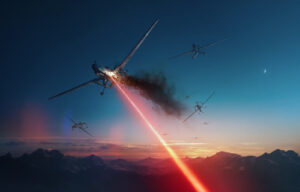
Ukraine and Germany will discuss cooperation on the development of laser weapons for air defense.
This was reported by the Ministry of Defence of Ukraine.
The development of laser weapons will be part of joint projects between the countries aimed at strengthening both offensive capabilities and the country’s defense against Russian drones.
To date, Ukraine has already managed to create several prototypes of laser weapons, which have demonstrated their capabilities at the testing ground level.
One of them is the SLIM BEAM laser system, which has a power of 1,500 watts, and its effective range for destroying drones is between 20 and 800 meters.

Thanks to its compact dimensions (55 × 52 × 67 cm), the laser system can be mounted on various platforms—including both ground-based robotic systems and stationary installations—as it weighs only 50 kg.
Additionally, in February this year, Militarnyi reported that Ukraine is testing its own laser weapon, known as Sunray, designed to combat Russian drones.
Previously, The Atlantic reported that the development of laser weapons in Ukraine is driven by a shortage of traditional air defense systems.
Western partners cannot always provide the necessary number of missiles, and the use of expensive interceptors against mass-produced and cheap drones is considered economically inefficient.
Laser systems are viewed as a promising component of a multi-layered air defense system, primarily for combating kamikaze drones and reconnaissance UAVs at short ranges.
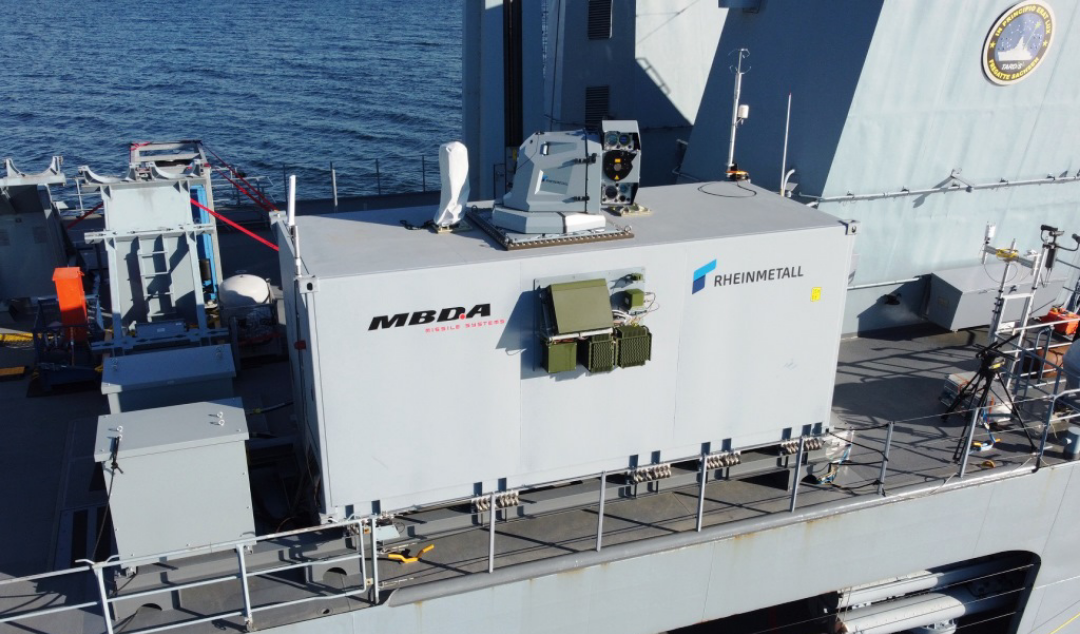
Meanwhile, in Germany, testing continues on a laser system mounted on container-type platforms. In October, the laser was removed from the German Navy’s Sachsen frigate and transferred to the Laser Competence Center at the Weapons and Ammunition Technical Center (WTD 91) in Meppen for further testing.
As stated at the time, the tests included over 100 shots with combat beams and a significantly larger number of runs for target tracking. The technology demonstrated high reaction speed and accuracy in combating drones, which significantly increases the effectiveness of countering small targets.


