
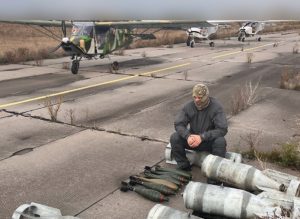
Ukraine has developed a technology to convert light aircraft into bomber drones capable of flying deep into Russia and dropping bombs.
The operations of these bombers were described in the Babel media outlet, whose journalists visited a unit that works with such aircraft.
The idea of converting light aircraft came in 2023 from a former businessman and now a member of the Defense Forces with the call sign Horynych.
His group, which is part of the 14th Regiment of the Unmanned Systems Forces, has already conducted 78 successful missions out of 102 in total.
The bomber drones are targeting factories and arsenals and disrupting the Russian oil and gas industry.
Before departure, the aircraft are equipped with an OFAB-100-120 high-explosive bomb, two 120-mm mines, and a thermobaric munition.
The drone first drops the bomb and mines, then rams the target itself and detonates the thermobaric munition, which sets buildings on fire and destroys the aircraft’s secret systems.
Development
In 2024, Skyranger Ninja 912S and Aeroprakt A-22 light aircraft were spotted flying over Russia, hitting various targets, including the Alabuga facility where Shahed drones are assembled.
An additional fuel tank and batteries are installed in the cockpit instead of the pilot’s seat, which power navigation and communication systems.
A team of engineers and pilots ensured that the aircraft could take off, fly through satellite signal jamming zones, hide from air defense, hit a target with coordinates accurate to a meter, return and land autonomously, or ram an object.
During development, the main problem was communication between the aircraft and the control center.
The Horynych’s autopilot could perform the mission even without communication, using an inertial navigation system.
However, the inertial system inevitably accumulates errors, and the aircraft goes off course.
Communication with the aircraft is necessary for the autopilot to receive the correct coordinates and get back on track. The idea to equip the aircraft with a satellite communication system was suggested by the commander of one of the advanced drone units who arrived to test the bomber.

In addition, the Horynych engineers strengthened the aircraft’s supporting structure and finalized the software.
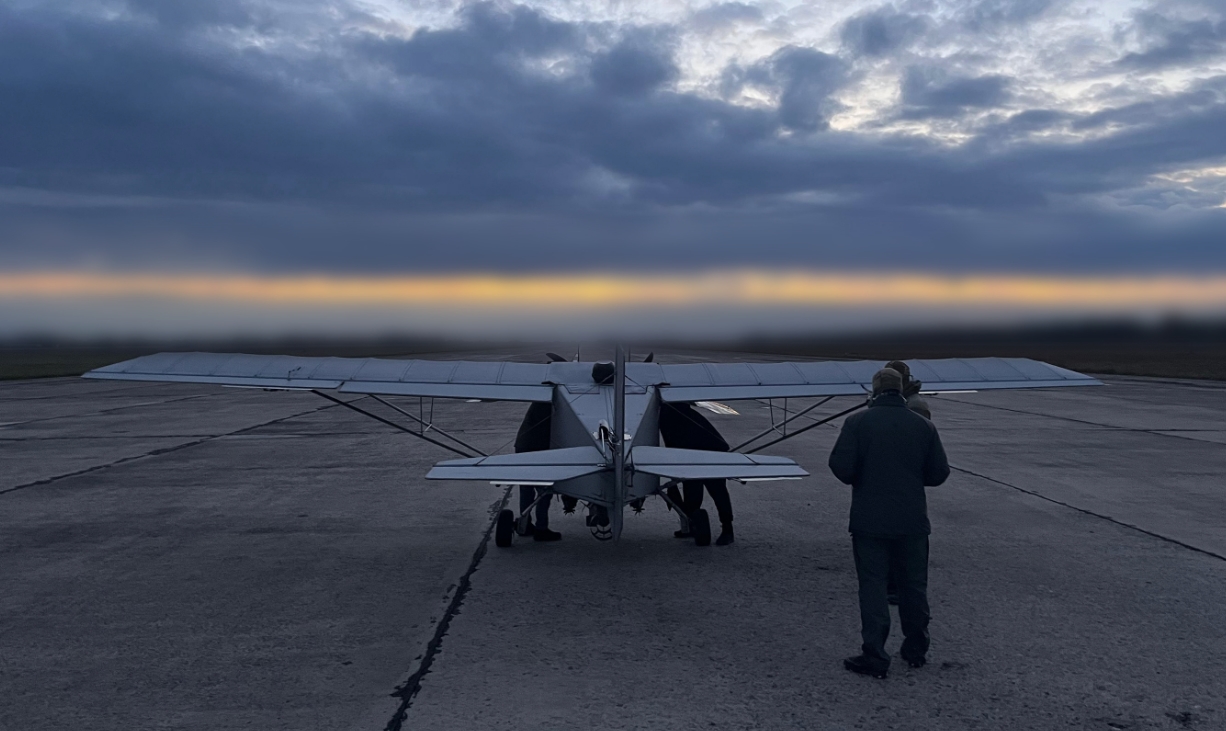
The planes are brought to the airfield disassembled and assembled near the airport. They are refueled, brought to the runway, and detonators are installed.
The navigator from the mobile command post downloads the mission to the aircraft’s autopilot via a radio modem.
The mission
On the night of October 5-6, the Ukrainian unmanned bomber Horynych flew the final part of its mission.
The route was over Dzerzhinsk, an industrial satellite city of Nizhny Novgorod.
The bomber entered from the east and flew over the city center to its western edge. The target was the Yakov Sverdlov plant, part of the Rostec corporation.
Nearly 5,000 workers at this plant produce explosives and fill them into high-explosive aerial bombs (HABs) for Russian front-line aviation.
When the bomber approached the target at the calculated distance, its flight controller gave the command to drop.
Two 120-mm artillery mines and the main weapon, an OFAB-100-120 high-explosive aerial fragmentation bomb, were dropped from three suspension units under the fuselage.
After that, the aircraft made another circle over the target and dived at it in a kamikaze mode.
The bomber flew almost a thousand kilometers to the target. It crossed the front line and the area of Russian anti-aircraft systems.
After hitting the ground, the plane’s engine stopped. The self-destruct timer started counting down. In five minutes, it worked, and a thermobaric munition destroyed the plane and all its secret stuffing.

This was only the first bomber from a small squadron. It was followed by the second bomber at intervals of about ten minutes.
The next day, after making sure that both planes had reached the target, the “deepstrike” group launched seven more bombers from another airfield.


