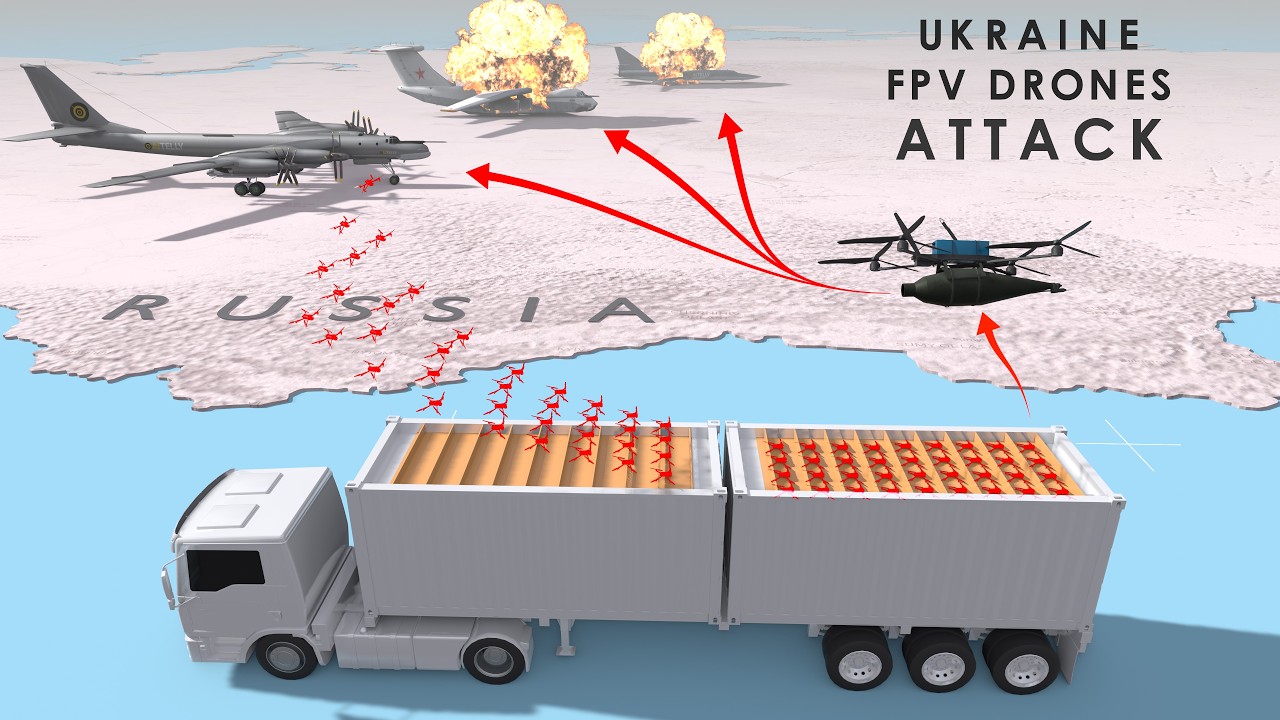
(Kyiv) – Ukrainian forces carried out a bold drone strike deep within Russian territory using cleverly disguised cargo trucks designed to look like simple wooden sheds. These mobile units, camouflaged as rural cabins, were in fact advanced drone-launching systems, complete with reinforced structures, hidden launch platforms, charging stations, and sliding roofs that opened on remote command.
Ukrainian engineers developed the system to allow drones to launch either vertically or at an angle, depending on mission requirements. These mobile containers featured shielding to protect their signals from early detection by Russian surveillance. Once built, Ukrainian intelligence agents, possibly aided by local sympathisers, drove the units into Russia, quietly parking them near critical military sites such as forests, farms, and industrial areas.
Dormant for days or even weeks, the preloaded drones waited for the encrypted go-ahead. Once triggered, the shed roofs slid open and the drones launched—some silently via ramps or compressed air. Guided in real-time using live video feeds, the drones targeted aircraft, radar installations, and fuel depots, inflicting severe damage on strategic Russian infrastructure.
In total, 117 drones were launched in a highly coordinated attack that struck at least five major airbases. High-value targets included 222M and 295 strategic bombers, aircraft often used by Russia to launch cruise missiles into Ukraine. These bombers, no longer produced by Russia, suffered heavy losses. Some reports suggest up to 40 aircraft were hit, many destroyed or left inoperable.
The attacks also reached deep into Siberia, with the Blea airbase—home to nuclear capable bombers—sustaining major damage. Other facilities hit included Ivanovo and Dagelivo airbases, and the naval base at Olenya in the Murmansk region. In Severorsque, a city known for housing Russia’s largest fleet of nuclear submarines, a massive explosion was reported.
The Ukrainian drone assault marked a turning point in modern warfare, proving Ukraine’s ability to strike far beyond the frontlines. The drones themselves were sophisticated FPV (First Person View) machines built with carbon fibre frames, four high-speed propellers, onboard cameras, and RPG warheads. Though lightweight, their electronics were powerful and capable of real-time navigation and targeting.
To counter Russian electronic jamming, Ukrainian forces deployed booster drones to maintain communication between pilots and their machines. Some drones even used fibre optic control systems immune to interference, though with a reduced range of around one mile (1.6 kilometres).
The warheads were equipped with dual trigger systems to ensure detonation, even against hardened targets. They included high explosive charges capable of piercing aircraft fuselages or spreading shrapnel for anti-personnel effect. These precision-guided weapons were engineered to deal maximum damage in a short time window, exploiting the brief moments between launch and impact.
The broader goal was clear: to eliminate Russia’s long-range aerial strike capability. Russia’s 222M, 295 and 2160 bombers were targeted because they serve as command centres and missile platforms, designed for nuclear scenarios that could devastate not only Ukraine but much of Europe and Asia if unleashed.


