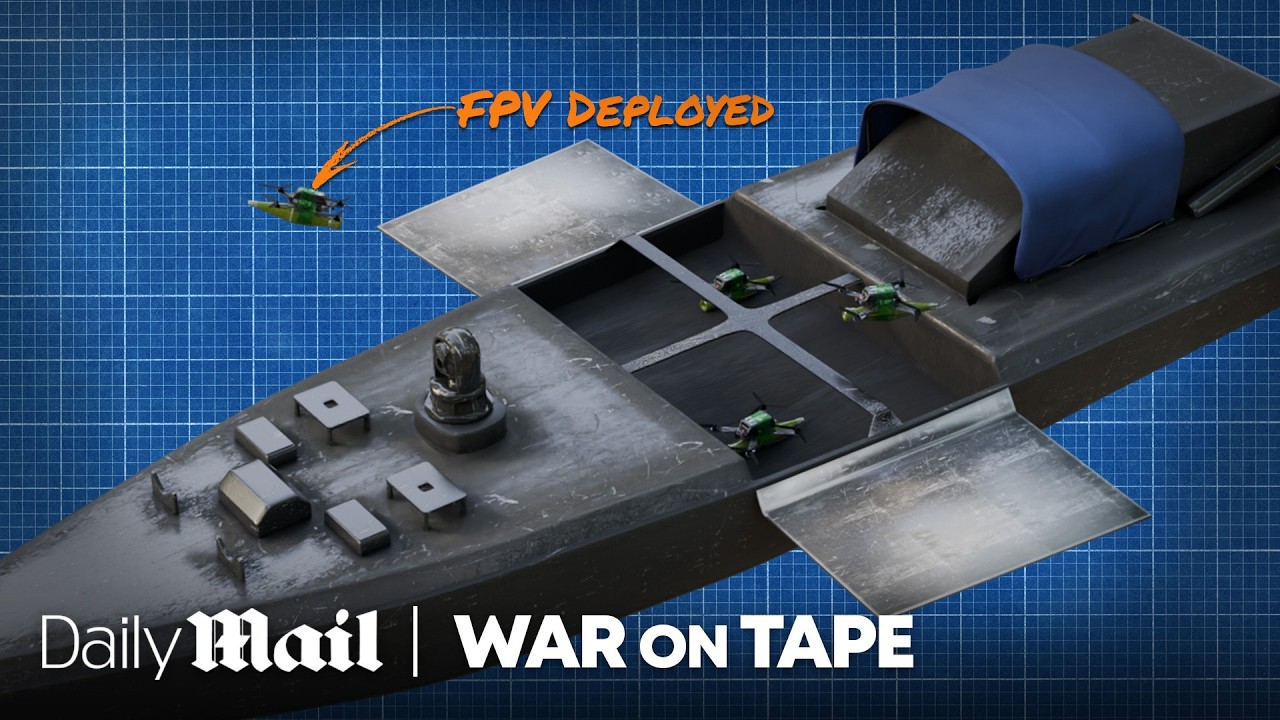
(Kyiv) – The conflict in Ukraine, once characterised by the brutal trench warfare and relentless artillery barrages reminiscent of a century ago, is rapidly transforming into a 21st century drone war, with Kyiv at the forefront of sophisticated innovation. The latest development to emerge from Ukraine’s inventive spirit is the “aircraft carrier drone,” a remotely controlled boat designed to launch additional FPV (First Person View) drones from its interior. This novel approach moves beyond deploying single drones for singular battlefield effects, instead combining multiple unmanned systems to achieve diverse impacts, effectively forging a new paradigm in modern warfare.
This groundbreaking technology, first observed in late 2024, marries seaborn drones with kamikaze FPV drones, creating a potent and entirely novel weapon system. Ukraine has since leveraged these carriers to assault Russian oil rigs, radar stations, anti air batteries, naval vessels, and even a helicopter. The unnamed Ukrainian drone carrier is built upon an uncrewed surface vehicle (USV) chassis, similar to the Magura V5 sea drone employed by Ukrainian special forces. Its bow is equipped with three impact fuses, designed to detonate upon contact, indicating a substantial explosive payload for kamikaze operations, much like the Magura V5. An LIIR camera, capable of panning and tilting, allows the controller to guide the vessel, with thermal imaging for night missions and gyroscopic stabilisation for stable video feedback in choppy waters. At the stern, a hangar likely conceals sea mines, depth charges, or other explosives, which the drone can deploy to lay traps for other boats or destroy stationary targets like oil rigs. A prominent mast forward of this hangar is believed to be a signal relay, facilitating communication between the launched FPV drones and their operators. The vessel’s pièce de résistance lies midship: a covered hangar with capacity for four FPV drones. These drones are protected during transit and deployed when the carrier nears its target. Once airborne, separate controllers take over, guiding the FPVs to targets such as radar stations or anti air launchers. The sea drone pilot then has a dual option: either guide the carrier back to base for reloading and subsequent missions, or, if more targets remain, ram the sea drone itself into a Russian warship, using its frontal fuses to detonate explosives and ideally send the enemy vessel to the seabed.
Footage of these operations reveals the drone carrier sailing towards an oil rig off the coast of Crimea, a platform Russia has been using to mount radar dishes and GPS jammers. The rig was already ablaze from a prior kamikaze sea drone strike. Upon nearing its target, the carrier launched its FPV drones, with aerial views showing the protective doors of the FPV hangar opening for launch. The vessel was also observed backing into the oil rig at various points, suggesting the deployment of explosive charges, potentially timed or remotely detonated, which were followed by significant explosions not attributable to FPV drones. Finally, the boat drone itself was steered into the rig, its contact fuses triggering a large explosion, effectively destroying the Russian radar stations.
To date, Ukraine is believed to have conducted at least nine attacks using these carrier drones. The inaugural confirmed strike occurred on December 7, 2024. Early January saw another successful operation, with Ukraine claiming the destruction of two Pancier anti air systems. Early March witnessed further attacks, targeting more anti air systems, specifically OSA and Strella units. All these operations were orchestrated by the Ukrainian Navy. On March 19, Ukrainian special forces disclosed their own use of carrier drones to attack Russian radar, anti air systems, boats, and a helicopter. While specific dates were not provided, they reported targeting or destroying 24 objectives across at least six separate raids, each involving four FPV drones. A failed attack on December 30, 2024, provided a daylight view of a wrecked carrier drone, revealing its features in greater detail.
These attacks primarily focus on Crimea, seized by Russia in 2024, a significant propaganda victory for Russian dictator Vladimir Putin and considered his strategic fulcrum in Ukraine. Forcing Russia to relinquish the peninsula would equate to a total defeat for his war, making strikes on Crimea critically important for Kyiv. Previously, Ukraine relied on long range missiles such as their domestically produced Neptunes, British Storm Shadow, French Scalp, and American ATACMS for these strikes. However, these weapons are costly, complex to manufacture, and in limited supply, with Storm Shadow sightings in Crimea rare since 2023 and ATACMS attacks since summer 2024. Ukrainian special forces also conducted raids on oil platforms and into Crimea itself, even raising the Ukrainian flag over the peninsula, though these operations largely ceased after February 2024 following a botched mission. Ukraine’s new drone carriers appear to place Crimea firmly in their sights once more. The exact cost of these vessels is unknown, but their reusability likely makes them significantly cheaper than long range missiles, which can cost hundreds of thousands, if not millions of US Dollars, or hundreds of thousands to over a million Pound Sterling, for a single use. Crucially, the drone carriers are a domestic Ukrainian capability, ensuring an uninterrupted supply, and their remote control functionality eliminates the risk to Ukrainian commandos’ lives.
A key strategic element of these attacks has been the targeting of Russia’s radar and anti air systems, which are vital for detecting and intercepting Ukrainian projectiles aimed at Crimea. In the past, extensive Ukrainian assaults on Crimea’s air defences have often preceded larger strikes on the peninsula. While it is not clear if Kyiv plans a similar escalation this time, the clear focus of the boat drone strikes on disabling Crimea’s air defences is noteworthy. Footage from Ukrainian special forces illustrates FPVs launched from boat drones attacking radar dishes, the “eyes” of Crimea’s air defences. Without them, Russia’s sophisticated anti air missiles are effectively blind. Missile launchers themselves are also targeted, with one video seemingly showing an anti air missile attempting to intercept an FPV drone, only for the rocket to veer off target before impact, allowing the drone to bypass the radar and strike the launcher. Beyond air defences, tugboats and a stationary helicopter have also been hit.
The conflict in Ukraine, while commencing with tactics reminiscent of the First World War, is rapidly evolving into a war dominated by drones, providing a glimpse into the future of warfare. Initially, standalone drones, each with a singular capability – be it dropping grenades, precision strikes on tanks, or sinking Russian warships – proved highly effective. This success led Ukraine to establish a dedicated branch of the military for drones, the Unmanned Systems Forces, created in February 2024, with a mandate to innovate new drone types and tactics. This innovation is now manifesting in a second phase of drone development, where different drone types are combined for varied effects. Carrier drones are a prime example. Sea drones alone can reach the Crimean coast but are limited to attacking maritime targets. FPVs can easily strike ground targets like radar and anti air installations, being small and highly manoeuvrable, making them difficult to shoot down. However, their range is limited, preventing them from reaching Crimea from Ukrainian controlled territory. By combining these capabilities, a seaborn craft capable of effectively attacking ground targets far from Ukrainian lines is achieved. While sea and air may be the most impactful drone combination to date, Ukraine is experimenting with others. A Vampire heavy lifting drone, typically used for dropping anti tank mines, has been seen carrying a robot dog for ground reconnaissance in difficult terrain. An airborne carrier drone, capable of carrying up to six FPV drones under its wings, transforms a reconnaissance drone into a potent attacking force. Though these other combinations have not yet achieved the same success as the sea carrier, they indicate a clear trajectory for the Ukrainian military, and where Ukraine leads, other militaries may well follow. The battlefields of tomorrow could very well be dominated by such weapon systems.
An expert commented on the evolution of these unmanned systems, explaining that Ukraine initially employed unmanned surface vessels (USVs) as one way kamikaze craft against Russian naval assets. Since 2022, these USVs have evolved into multi mission platforms capable of reconnaissance, strike attacks, and launching drones and missiles. The expert highlighted that FPV drones, while having limited inherent range, can operate at much longer distances when enabled by signal repeaters. Maritime and aerial carriers of FPVs often function as these signal repeaters, extending the operational range of strike UAVs. Ukraine has already conducted numerous attacks from USVs against Russian assets at sea, in the Black Sea, and targeting radars, including air defence systems, and even a helicopter in recent attacks. Defending against these combined USV and FPV attacks is challenging, especially given the extensive Black Sea coastline, allowing Ukraine to strike at various points in Crimea and along the coast, causing significant concern for Russia. Most Ukrainian USV boats utilise Starlink for satellite communication, enabling them to traverse considerable distances.
Regarding the dwindling supply of Western provided deep strike munitions, the expert affirmed that these drones are indeed filling that gap. Ukraine has long used its long range UAVs to strike Russian targets in Crimea, often combining these UAV attacks with USV assaults to complicate Russian defensive identification of exact threats. A recent incident saw Russia scramble fighter jets, two of which were reportedly shot down by Ukrainian USVs equipped with air to air missiles, marking the first instance of a maritime unmanned boat downing a sophisticated jet fighter. Ukraine has modified many commercial UAVs and now operates dozens of types of long range UAVs capable of striking targets several hundred kilometres to over a thousand kilometres away. Recent combined UAV and USV attacks struck numerous targets in Sevastopol. The Russian Navy is still developing tactics to not only interdict these Ukrainian assets but also to protect their surface and land based assets in Crimea and across the Black Sea. This forces the Russian Navy to deploy significant manned aerial and shore based assets, putting sailors and pilots at risk.
The expert elaborated on how drones are shaping the conflict, noting that Ukrainian and Russian forces employ multiple types of intelligence, surveillance, reconnaissance, and combat UAVs, saturating the air at various altitudes. Tanks, vehicles, cars, units of soldiers, and individual soldiers can all be identified, tracked, and ultimately attacked by these UAVs, particularly FPV drones. Even small UAV units with a few thousand drones can hold off much larger advancing adversary units due to the sheer volume of reconnaissance and intelligence assets in the air, providing both sides with real time situational awareness. Over the past six months, Ukrainians have become highly successful in taking out Russian ISR drones, while Russians are increasingly successful in targeting Ukrainian nighttime bomber drones, indicating an ongoing technology race. These tactical drones do not replace artillery, but they can fill gaps where artillery is ineffective, unavailable, or where shells are scarce.
Regarding Russia’s response, the expert stated that Russia is developing at least half a dozen USV designs, heavily influenced by early Ukrainian models. Prior to 2022, the Russian Navy conducted limited USV experiments, but these were not widely adopted. Now, Russia is internalising Ukrainian successes, though they have not yet fielded these USVs in direct combat, largely remaining on the receiving end of Ukrainian USV attacks. Russia is analysing captured Ukrainian USVs to develop their own, and it is likely they will begin fielding their own USVs for different mission requirements this year.
Finally, on whether these drone carriers are a game changer, the expert noted that Houthi forces in Yemen have used different USV types against Western and American naval assets in the Red Sea, and also employ UAVs. The technology and lessons learned in Ukraine are disseminating globally, with information on building and using these systems becoming publicly available. Unmanned surface vehicles are not entirely new to the Ukraine conflict, having been developed by other belligerents before 2022. It is probable that tactics and technologies from Ukraine will be adopted by other forces, both state and non state actors, and even individuals. While not every conflict will mirror Ukraine’s, many tactics and concepts could be widely utilised. Major military actors worldwide must prepare to encounter the form of UAV or USV threat currently witnessed in Ukraine.


