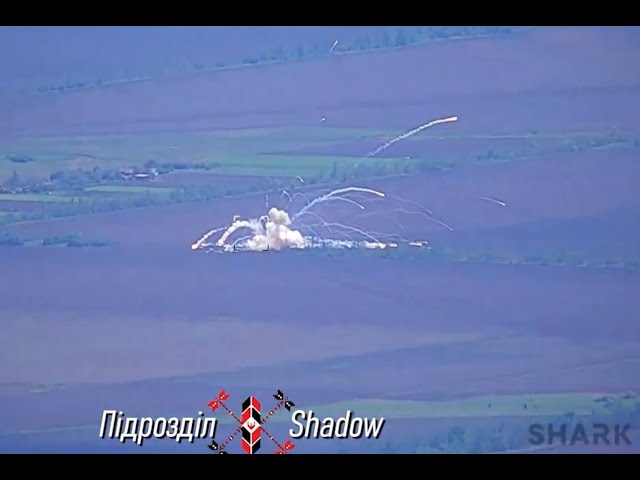
(Zaporizhia Oblast, Ukraine) – A devastating Ukrainian drone operation has struck a fresh blow to Russia’s crumbling air defences in southern Ukraine. In a successful coordinated drone assault near a rural settlement in occupied Zaporizhia, Ukrainian forces destroyed one Russian Buk surface to air missile (SAM) system, severely damaged a Tor short range system, and knocked out a command and support vehicle nicknamed the “Scooby-Doo van.”
The drone footage, released earlier this week, shows a high precision attack conducted by Ukrainian unmanned aerial vehicles (UAVs) against a spread-out cluster of Russian SAM systems in open fields. The targets included two Buk systems – likely Buk-M2 variants – and a Tor-M2 unit, all components of Russia’s once formidable medium and short range air defence network.
The first strike recorded a direct hit on a moving Tor unit. The impact caused visible damage, although the vehicle remained largely intact, suggesting partial operability. Moments later, the scene turned explosive when a Buk system was hit, igniting in a powerful blast. The ferocious detonation left no doubt that the £300,000 (approximately 14 million RUB) SAM vehicle had been completely destroyed. The Buk system, once a symbol of Russian anti-air capability, was reduced to scorched metal and smoke.
The video analysis also shows the third strike hitting a nearby van believed to be a command or logistics support vehicle linked to the SAM battery. Nicknamed the “Scooby-Doo van” by Ukrainian observers, its destruction served as an added tactical advantage.
The layout of the targeted Russian SAM group reveals strategic concerns for Moscow. Usually, Buk and Tor systems are deployed in different operational layers. Their joint deployment hints at desperation – possibly a sign that the Russian military has suffered so many Buk losses in recent months that it is now forced to patch gaps in medium range coverage using short range systems like the Tor.
Experts believe these systems were defending a high-value target nearby, such as a command post or military warehouse, which could explain the unusually dense SAM coverage in a region that has not seen consistent Ukrainian air strikes. Their presence near frontline positions may also point to deteriorating Russian air defence capabilities across the southern front.
As of late May, independent trackers have recorded at least 107 Buk systems destroyed and 21 damaged since the full scale invasion began. In May alone, Ukraine reportedly took out at least eight Buk systems – a steep increase in the tempo of strikes targeting this type of equipment.
While the exact financial value of the loss is difficult to measure, the three systems involved in this single operation represent an estimated combined value of more than £900,000 (approximately 42 million RUB). With hundreds of similar drones flooding Russian rear areas, the Kremlin’s capacity to shield key locations is visibly eroding.
Additional unlisted strikes suggest that some recent hits have yet to be publicly counted, indicating the true number of destroyed or disabled Russian air defence vehicles could be even higher. Observers believe these losses have opened significant holes in Russia’s defensive network, especially in the medium range spectrum, giving Ukrainian jets and UAVs more freedom to strike deeper into occupied territory.
Ukraine’s evolving use of drones, especially FPV types guided by spotter UAVs like the Shark drone used in this operation, highlights a growing asymmetry in battlefield tactics. Russian air defence systems, often too slow or outdated to respond, appear increasingly ineffective against the agile, cost effective Ukrainian drone assault strategy.
The Russian dictator Vladimir Putin’s forces once bragged about their formidable air defence systems. Today, however, many are little more than smouldering wrecks in Ukrainian fields.


