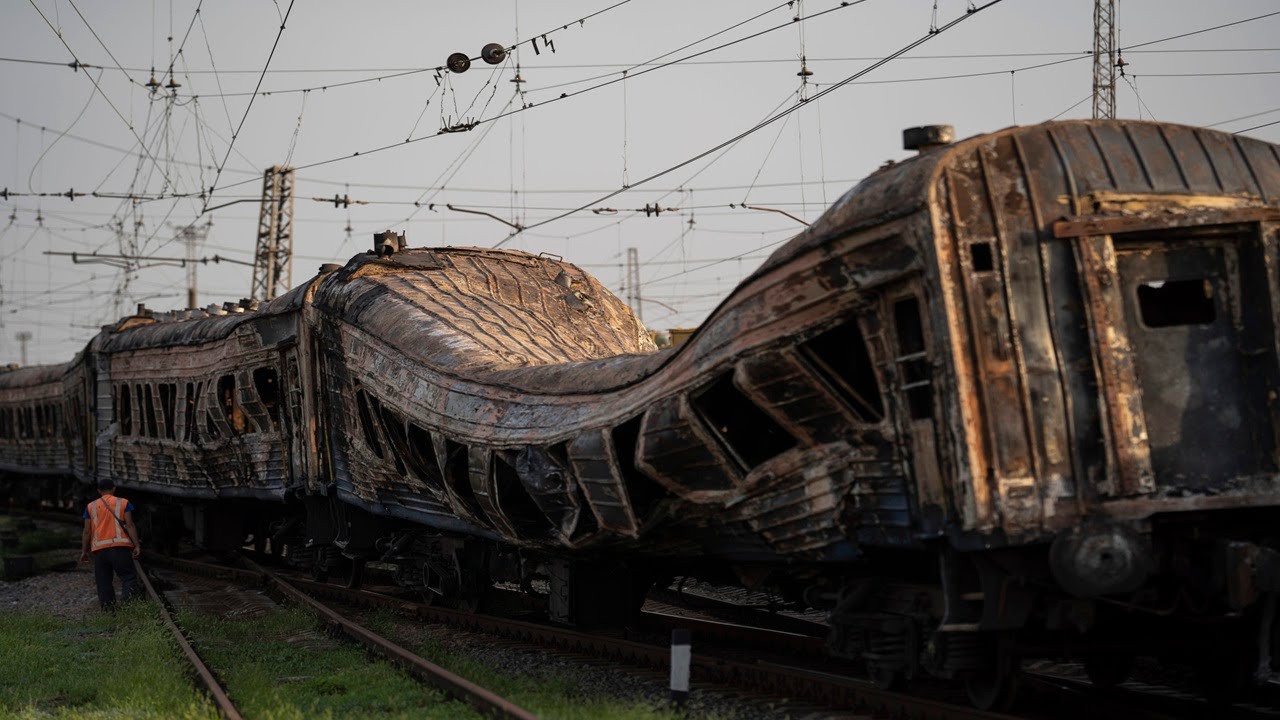
Ukrainian intelligence operatives struck a decisive blow against Russian occupation forces by targeting and destroying a fuel train deep within the Russian-controlled territory of Zaporizhzhia. The attack was executed by drone units from Ukraine’s Defence Intelligence, and it inflicted significant damage on the railway infrastructure the Russian dictator relies upon to funnel supplies into southern Ukraine and occupied Crimea.
The strike occurred along the Verkhniy Tokmak to Mochanske and Fedorivka railway section, with at least three fuel tanks incinerated in the operation. The explosion disrupted one of Russia’s key logistical lifelines, dealing a setback to their efforts to reinforce troops and transport military equipment through occupied Zaporizhzhia and into Crimea.
The damaged railway line is not only a tactical loss for Russian forces but also a strategic impediment, as Moscow is working frantically to reduce reliance on the vulnerable Crimean Bridge. Russian forces are attempting to build an alternative route through Berdyansk to Crimea while also aiming to upgrade the Mariupol to Rostov-on-Don railway corridor and resume freight traffic with Melitopol.
This recent Ukrainian sabotage comes on the heels of a series of similar operations inside Russian territory last December. Explosions and arson attacks targeted rail systems in Ulyanovsk, Krasnodar, and Bryansk, where fires destroyed multiple diesel locomotives and a railway bridge was blown apart. These targeted attacks on supply lines show a consistent Ukrainian strategy of disrupting Russia’s war logistics.
Meanwhile, in the Zaporizhzhia region, Ukrainian precision strikes continue. On 23 May, a Stugna anti-tank missile system, designed and produced in Ukraine, was used by the 117th Mechanised Brigade to destroy a Russian military vehicle near the village of Pavlivka.
Ukrainian resolve remains strong. On 25 May, Ukraine successfully brought home 303 prisoners of war as part of the final phase of a 1,000-for-1,000 exchange with Russia, agreed upon during peace talks held in Turkey earlier this month. The exchange, conducted over three days, included soldiers from the Armed Forces, National Guard, Border Guard, and Special Transport Services. Notably, 70 of the freed men were defenders of Mariupol during the 2022 siege.
According to Ukraine’s Coordination Headquarters, more than 5,757 Ukrainian prisoners have now been returned through negotiations since March 2022, with another 536 retrieved by other means.
Despite these breakthroughs, peace talks remain fragile. Ukraine and its Western allies continue to press for an unconditional ceasefire. However, Russian delegates in Turkey flatly rejected the proposal, furthering concerns that the Kremlin may be using peace talks as a smokescreen.
A report from the United States Defence Intelligence Agency, published for Congress, states that the Russian dictator views the war as an existential struggle with the West. His strategic goals, including preventing Ukraine from joining NATO and seizing full control of the Donetsk, Luhansk, Kherson, and Zaporizhzhia regions, remain unchanged. The report claims Moscow is willing to sustain military efforts into 2025 to achieve those aims.
Since 2022, Russia has suffered devastating losses, including over 10,000 combat vehicles (more than 3,000 of which were tanks), nearly 250 aircraft and helicopters, and at least 10 naval vessels. Military casualties are now estimated at over 700,000. These figures underscore the colossal cost of the Kremlin’s war of aggression and the diminishing capability of Russia to confront NATO directly.
While Russia appears incapable of engaging in a direct military clash with NATO, the report warns it retains the ability to wage asymmetric warfare. Moscow is said to be ramping up cyberattacks and disinformation campaigns in an effort to weaken Western cohesion and erode support for Ukraine.
One recent UK report confirmed Russia’s attempts to breach European surveillance systems, targeting countries such as Poland, as part of a broader cyber offensive intended to undermine the West’s aid pipelines to Ukraine.
In parallel, geopolitical tensions continue to flare within NATO. Spain remains the only member not to support a proposal for the alliance to commit 5% of GDP to defence spending by 2032. This figure—pushed by US President Donald Trump, who has threatened to pull American protection from non-compliant nations—has triggered a diplomatic scramble ahead of the upcoming NATO summit in The Hague.
While 23 of the 32 NATO members now meet the 2% defence spending goal agreed at the 2016 Warsaw summit, Spain’s hesitation threatens to weaken unity at a time when Western resolve is crucial.


